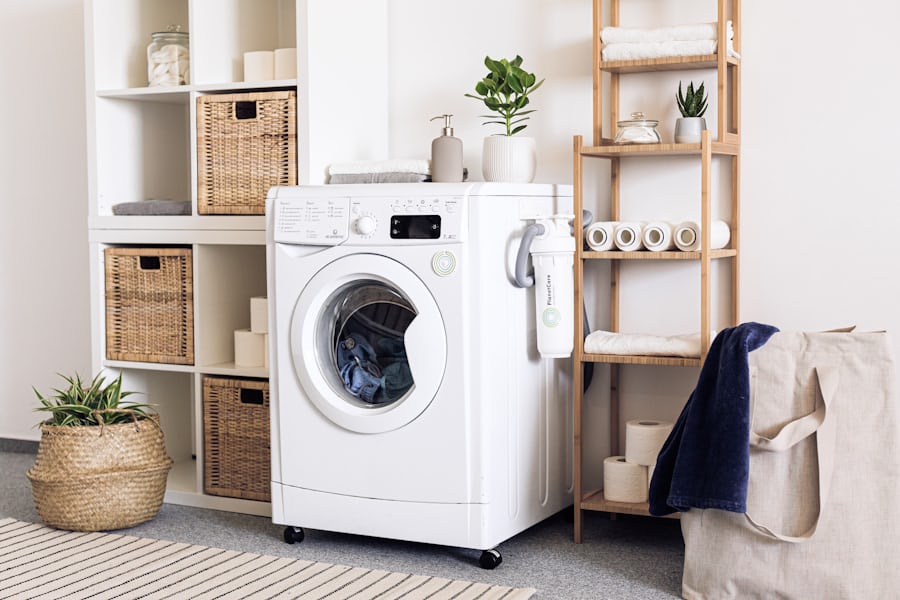
A washer that fills with water but never spins is the second-most common washer call we run across metro Atlanta — right behind “will not drain.” The motor hums at the start of the spin cycle, then everything stops and the cycle hangs forever.
The fix is almost always one of five components, and three of them are inexpensive. This guide walks the diagnostic order our techs use on Atlanta service calls.
The washer cannot spin until the drum is drained. If the drain pump or drain hose is blocked, the cycle stops without spinning — but the actual fault is the drain, not the spin system.
Run a Drain & Spin cycle. Listen for the drain pump (a quick whirring sound). If you hear nothing or the water stays in the tub, the drain is the underlying issue. See our drain-fault notes inside the Atlanta washer service page for that path.
Top-load washers have a small switch at the top-front of the cabinet that detects whether the lid is closed. The washer refuses to spin if the switch reads open. After 8–12 years the switch contacts wear out and the washer thinks the lid is open even when it is closed.
Quick test: Lift the lid during a cycle — the washer should pause. Close the lid — the cycle should resume. If closing the lid does not restart the cycle, the switch has failed. Replacement is $25–$60 in parts and a 30-minute repair.
Front-load washers use a more complex interlock that locks the door magnetically and reports the lock state back to the control board. If the interlock fails, the cycle pauses with a door fault and never enters spin.
Common error codes: F8 E2 (Whirlpool), dE (Samsung), dE / dE1 (LG). All three point to the door interlock. Replacement is a flat-rate part swap, usually 30–45 minutes.
Most front-load and many top-load washers use a drive belt between the motor and the drum pulley. Belts wear and stretch over 8–12 years, especially on heavy-use households. A loose or broken belt means the motor runs but the drum does not turn.
Visual confirmation: Tip the washer back and look underneath. A slipped belt sits loose; a snapped belt is in pieces in the cabinet base. Replacement is $20–$50 for the belt and 45–60 minutes of labour.
On direct-drive top-load washers (older Whirlpool, Maytag, GE), a small plastic coupling connects the motor to the transmission. The coupling is designed to fail before the motor — it shears off when the drum is overloaded.
The motor itself can also fail electrically after 10–15 years. Coupling: $20 part, 60 minutes labour. Motor: $200–$350 part, 90 minutes labour — on washers under $700, replacement is often the better call.
Modern washers detect drum imbalance during spin. If a load piles to one side, the washer slows, redistributes, and tries again. After three failed attempts it gives up and the cycle ends with the drum still wet.
Try this first: Pause the cycle, redistribute the load by hand, restart Spin Only. If the washer spins fine with redistributed laundry, no repair is needed — just avoid washing single bath mats or single bedsheets alone.
If the cycle keeps hanging despite a redistributed load, the issue is hardware — not balance. Our Atlanta washer repair team stocks lid switches, door interlocks, drive belts, and motor couplings for all major brands.
For brand-specific failure patterns, see LG washer support (dE codes), Samsung washer help (dC codes), or Whirlpool washer support (F8 codes).
Flat-rate diagnostic across metro Atlanta. We carry lid switches, door interlocks, belts, and motor couplings on the truck.
Schedule washer repair Atlanta now